
EXPLORE BY LOCATION
Two Cornerstones of the Trail


LISTEN AS YOU EXPLORE
Audio Tour Experience
Narrated stories from key locations along the trail — explore the history at your own pace. The full library features 41 stops across eight themes.
Africatown (#2)
Union Baptist Church (#38)
Plateau Graveyard (#31)
Wallace Turnage (#8)
HISTORIC MARKERS
Marking the Places That Made History
A selection of the 44+ sites along the trail. Each marker tells the story of a person, place, or institution that shaped Mobile's African American history.

Dave Patton House
Built in 1915, the Dave Patton House stands as a powerful testament to the life and work of Dave Patton — a visionary entrepreneur, builder, and community leader.

Judge Virgil Pittman
Thomas Virgil Pittman was born on March 28, 1916, in Enterprise AL. He graduated from the University of Alabama, in 1939 and its School of Law, in 1940. In June 1966, President Lyndon Johnson nominated, and the U.S. Senate confirmed, Judge Pittman to the United States District Courts for the Middle and Southern Districts of Alabama. He served as Chief Judge of the Southern District Court for the Southern District of Alabama from 1971-1981, when he assumed senior status.

Caldwell School
Broad Street Academy was the first public high school in Mobile for African-Americans. Founded in 1887.
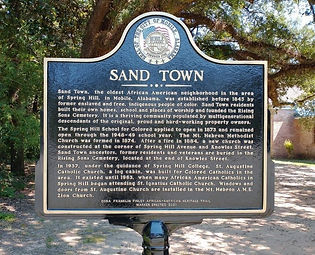
Sand Town
Established before 1845, Sand Town predates the United States Civil War and is the oldest African American neighborhood in Spring Hill.

Stone Street Baptist Church
Alabama’s oldest Baptist Church founded in 1806 by slaves freed by their master.

National African-American Archives
Designed as a miniature replica of the Mobile Public Library and only option for black Mobilians during Jim Crow era.

Dr. H. Roger Williams
First black owned Drug Store in Mobile. "Live and Let Live" opened in 1901. Williams was a published writer, poet, and orator.

Creole Firehouse #1
The first volunteer fire company in Alabama. Founded in 1819 by members of Mobile’s Creole community.
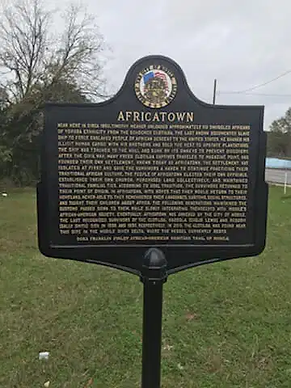
Africatown
Africatown is the site in Mobile, Alabama, along the Gulf Coast where the last cargo of Africans landed in 1860. Their landing marked the last recorded attempt to import Africans to the United States for the purpose of slavery.

Restoring Justice

Christopher First Johnson House
Founded The Union Mutual Aid Association - Mobile's first black life insurance company. By 1920 Johnson had written over $9 million in insurance. He was the ninth pastor of St. Louis Street Baptist Church.

Dunbar/Central High School
Produced a culturally diverse curriculum that exposed students and the African-American community to the arts during the Jim Crow Era.

Vivian Malone Jones
She was one of the first two black students to enroll at the University of Alabama in 1963, and in 1965 became the university's first black graduate. She was made famous when George Wallace, the Governor of Alabama, attempted to block her and James Hood from enrolling at the all-white university.

Union Baptist Church
African survivors of the Clotilda Organized Union Baptist Church in 1869 in Africatown. Cudjo Lewis, was the last survivor of the Clotilda. He died in 1935.

Old Plateau Cemetery
Final resting place of the Clotilda survivors in Africatown. Obelisk marking Cudjo Lewis’ grave was donated by the Delta Sigma Theta Sorority.

Christian Benevolent Funeral Home
First Alabama mortuary owned by an African-American woman, Mrs. Pearl Johnson Madison.
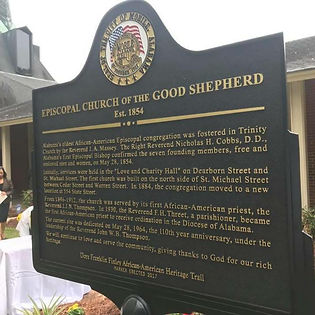
Church Of The Good Shepherd
Established in 1854, the Episcopal Church of the Good Shepherd is the oldest black Episcopal congregation in Alabama and the third oldest Episcopal congregation in the state.

Dr. Thomas N. Harris
The first licensed African-American physician in 1900. He established Mobile’s first medical facility for Blacks in 1905.

Wiley L. Bolden Sr.
Mr. Wiley L. Bolden, Sr., along with John L. LeFlore, was a leader of the Mobile, AL Chapter of the NAACP and a veteran civil rights activist.

Andrew N. Johnson
Successful entrepreneur and community advocate at the turn of the century. He owned People's Drug Store, Johnson Mortuary, and published the "Mobile Weekley Press".
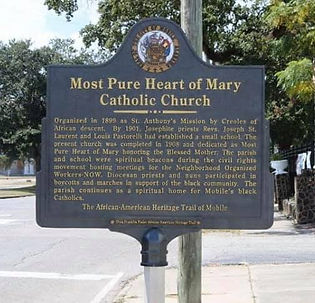
Most Pure Heart of Mary
First African-American Catholic Church in the City of Mobile. Supported the Civil Rights Movement during the 60’s.

Johnson and Allen Mortuary
Alabama’s oldest black Mortuary.

John LeFlore Non-Partisan Voter’s League Office
Instrumental in desegregating schools, rail cars, postal service, and the police force in Mobile.
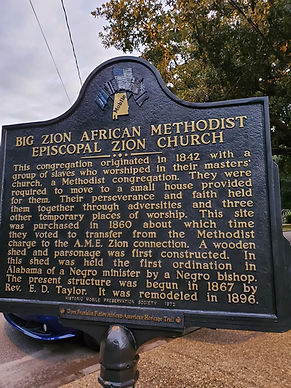
Big Zion Church A.M.E. Church
The present building was constructed in 1867 and sits on the corner of Church and Bayou streets. The Church is listed in the national register of Historic Places.
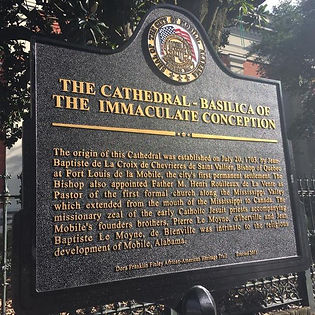
Basilica of the Immaculate Conception
Records of the parish date back to 1704 and record the births, baptisms, marriages and deaths of Mobile’s diverse origin.
Historic Markers Revealed
Tour Maps
 |  |  |  |
|---|